
Email marketing results, but it tends to be time-consuming and repetitive. Marketers often face writing barriers, spend hours on drafts, and struggle to start campaigns quickly. Expanding personalized emails for different segments adds more pressure. AI email writers solve this problem as useful assistants rather than substituting human creativity. These tools can quickly generate, improve and personalize emails based on simple prompts, allowing marketers to focus on strategy and analysis.
This guide explains the step-by-step framework for defining, mechanisms, benefits, and effective utilization of AI email writers. By the time you finish reading, you'll see how to create better emails faster and smarter for 2026.
What is an AI Email Writer?
AI Mail Creation Tool is a tool that generates e-mail drafts by utilizing artificial intelligence such as large language models (e.g.: GPT-4). Create an email draft based on prompt, propose subject, and improve content. These tools are designed to help marketers create ideas, draft, and personalize. It does not replace human strategy planning or final editing. Marketers will still set goals, define target tones, and determine brand tones.
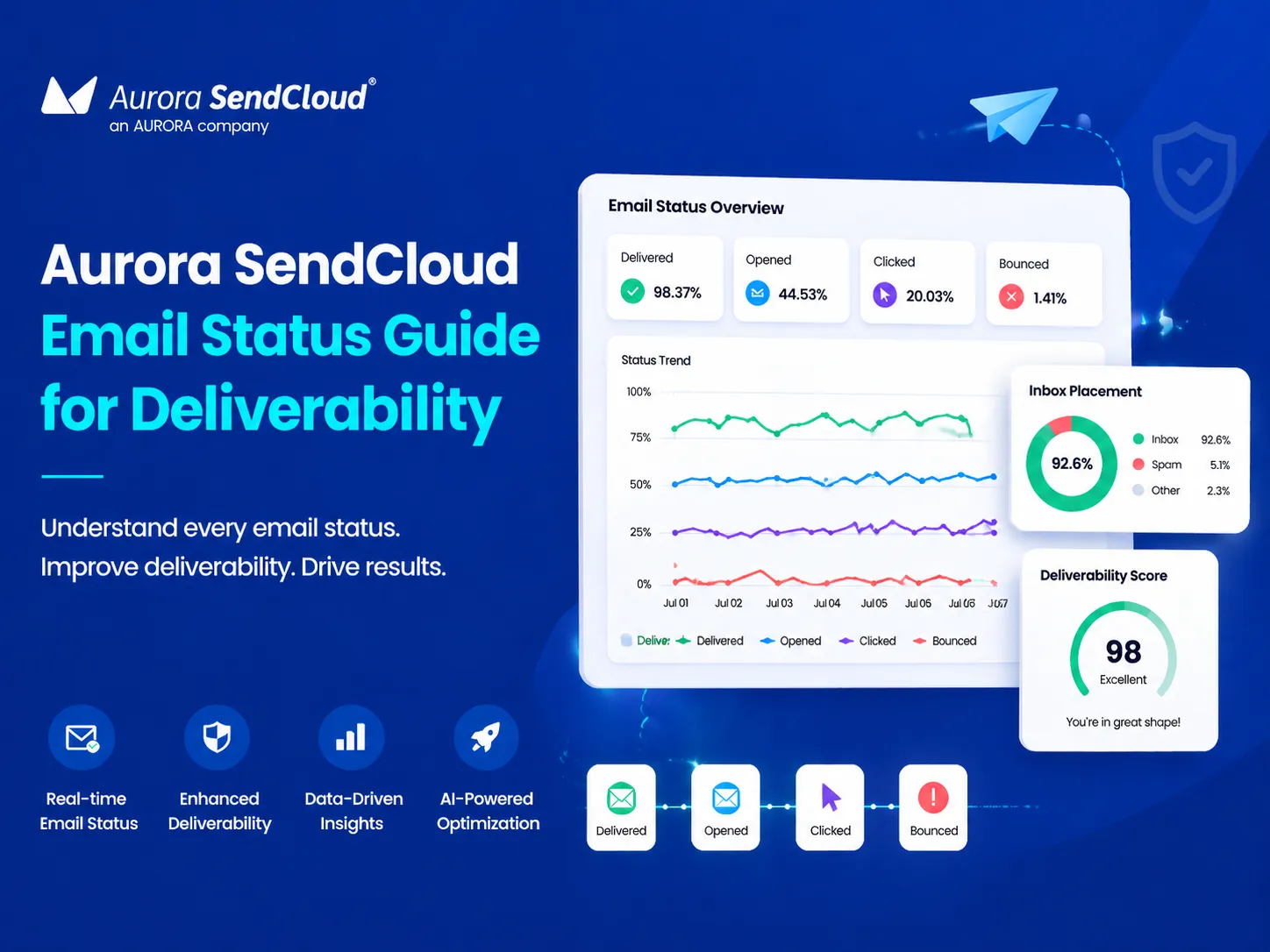
AI e-mail creation tools have variousforms, such as standalone platforms, browser extensions, and functions integrated with email service providers (ESPs). Some ESPs, such as Aurora SendCloud, integrate native AI writing assistants in the drag and drop editor to create, edit, and optimize emails without leaving the platform.
Why Use an AI Email Writer?
AI e-mail creation tools help marketers save time, improve creativity, and improve the results of email campaigns. Reduce hours of work to minutes by creating ideas, drafting content, and automating email personalization for different audiences. AI helps you quickly create multiple email versions, optimize subject lines for better engagement, and maintain a consistent brand voice. These tools are designed to enhance human workflows, allowing marketers to focus on strategies while AI handles repetitive writing tasks efficiently.
The main advantages AI email writers bring to marketers are:
- Overcoming creative blocks and generating ideas: The AI tool converts blank pages into multiple subject and content proposals in seconds to accelerate brainstorming.
- Increase production speed: 50-80% faster email drafting, increase campaign count, A/B test, and rapid launch.
- Enlarge personalization: Automatically generate personalized content for different customer segments, such as new and existing customers.
- Increase engagement and delivery rate: Propose subject linesthat increase opening rates and remove expressions that trigger spam filters.
- Unified brand tone: AI can be learned by past emails to generate content that matches your style and tone.
The 5-Step Guide to Using an AI Email Writer
AI email writers have the greatest effect when used in a structured workflow. The following five steps show you how to create high-performance, personalized and professional emails while saving time. Each step ensures that the AI output is in line with marketing goals and brand tones.
Step 1: Define Your Goal & Audience
Clearly define the purpose of the email before using AI. Promotional offers, nurturing sequences, trade notices Next, identify the target segment that guides the AI tone and message. By understanding the target, e-mail leads to empathy and engagement improvement.
- Determine email types: promotions, information, transactions
- Identify audience segments: New Users, Repeater, VIP
- Specify desired tone: friendly, formal and persuasive
This clarity makes AI generate content that matches the purpose.
Step 2: Craft a Powerful Prompt
The prompt determines the quality of the AI generated email. Avoid ambiguous instructions like "Create Sales Mail" and provide clear and detailed prompts: "For SME managers, create friendly and merit-oriented emails that promote the new analytical capabilities of our SaaS tools. Emphasize time-saving and data-driven determination, including curiosity-stimulating subjects. "
Tips
- Include readership and purpose in prompts
- Highlight key benefits and offers
- Compare vague and detailed prompts to see better results
A powerful prompt ensures that AI generates relevant and practical drafts.
Step 3: Generate, Review & Refine
Generate multiple email drafts using the AI tool to explore different tones, formats, and messages. Carefully review each draft to check accuracy, clarity, and logical flow. Make sure the content matches your brand voice and campaign goal. Use follow-up prompts to refine the results, such as shortening sentences, adding urgency, or highlighting a key benefit. This review process helps turn basic AI drafts into polished, professional emails that are ready for real audiences.
Example of improvement:
- "More concise"
- "Add urgency"
- "Focus on this major advantage"
If your AI is integrated into a drag-and-drop editor like Aurora SendCloud, you can edit, preview and finalize emails in real time. With repetitive reviews, emails are professional, brand-aligned and ready to effectively attract audiences.
Step 4: Personalize & Segment
AI makes it easy to adjust one email draft for different audience groups without rewriting everything from scratch. By changing the prompt, you can focus on each group’s needs, pain points, and expectations.
For example, new users may need onboarding guidance, while loyal customersrespond better to exclusive offers. AI helpstailor messaging, tone, and value points for every segment. This targeted approach improves relevance, increases open and click rates, and ensures each recipient receives content that feels personal and useful rather than generic.
- New users: Highlight the benefits of onboarding and trials
- Royal Customers: Highlight exclusive and loyalty benefits
- Prospect: Focus on solving key challenges
This facilitates large-scale personalization and increases relevance and engagement for all recipients without manually creating multiple drafts.
Step 5: Final Human Touch & Compliance Check
Be sure to make human adjustments before sending. Include anecdotes, brand-specific expressions and personal insights. Verify the accuracy of all statistics, links and claims. Verify compliance with regulations such as GDPR and CAN-SPAM.
Tips:
- Edit tone, clarity and readability
- Reconfirming factual information
- Confirmation of compliance with email marketing rules
Combine AI efficiency with human monitoring to deliver professional, brand-aligned and legally compliant emails.
Common Beginner Mistakes to Avoid
AI email creation tools speed drafts and personalization, but beginners tend to fall into common pitfallsthat reduce effectiveness. Relying solely on AI without proper guidance can lead to generic content, errors, and inconsistencies in messages. Understanding these mistakes allows marketers to leverage AI more efficiently while maintaining quality and brand consistency.
This section describes the most frequent mistakes of beginners, such as ambiguous prompts, omitting human reviews, and excessive reliance on AI in terms of strategy. Provide guidance to avoid these and get the best results from email campaigns.
Common mistakes:
- Expect perfection in the first time without repetitive prompt adjustments
- Use AI-generated content without human editing to generate generic or brand-free emails
- Provide ambiguous or contextual prompts and generate unavailable drafts
- Fails to verify the statistics and claims generated by AI
- overly dependent on AI for strategy formulation; Marketers need to define goals and tones
By avoiding these pitfalls, you can maximize the use of AI mail tools.
Conclusion
AI email writers have become a practical tool for modern marketers. They help save time, reduce writing stress, and improve email quality without replacing human control. When used correctly, AI supports faster drafting, better subject lines, and easy personalization for different audiences.
The key is to treat AI as a helper, not a decision maker. Tools like Aurora SendCloud make this process even easier by offering built-in AI writing support directly inside the email editor. This allows marketersto write, edit, personalize, and launch campaigns from one place. In 2026, using AI-powered email tools is essential for smarter and more efficient email marketing.