

Email plays a huge role in how businesses grow today. If your messages don’t land in the inbox, your marketing doesn’t work. Your customers may never see important updates. And your sales can drop before you even realize what happened. Demand Sage reports that people send about 376.4 billion emails .
That’s why choosing thebest email delivery service matters more than ever. Not every provider offers strong inbox placement, and not every system keeps your messages safe. So the real question becomes, how do you know which one is right for you for email marketing ?
You don’t have to guess. The answer lies in simple, clear, easy-to-understand email deliverability metrics . These numbers tell you how well a service performs. They show where your emails land, how fast they move, and how much trust each provider builds with your audience. This guide breaks down the seven key metrics you need to compare email delivery services and choose the right one. Read on to learn more.
What Defines the Best Email Delivery Service Today?
Finding the best email delivery service isn’t only about sending messages. It’s about how well that service supports your entire email journey. Here are the four pillars that set a great provider apart.
- Speed and Reliability: Nobody likes delays. In email, even a few minutes can feel like forever. A good provider sends your messages fast and stays up 24/7. If the API is slow or the system keeps going down, you’ll feel it right away. Your customers will too.
- High Deliverability: Strong deliverability keeps your emails out of the spam folder. This is the heart of email marketing success. High inbox placement means more people open, read, and act on your emails.
- Scalability: Holidays, product launches, flash sales sometimes your email volume jumps overnight. The right service should handle spikes with no stress. When your business grows, your email system should grow with you.
- Analytics and Tracking: You can’t improve what you can’t see. Analytics help you track opens, clicks, bounces, devices, and more. This data helps you make smart choices instead of guessing.
The-7-Key-Metrics for Evaluating Email Delivery Services
Now let’s walk through the seven must-know metrics. These are the real deal-breakers that help you compare providers, including Aurora SendCloud , in a fair and clear way.
1 Email Deliverability Rate: The Most Important Benchmark
If you only remember one metric, let it be this one. Deliverability rate shows how many emails actually reach your audience. Not “sent,” but “landed in the inbox.” There’s a huge difference. An email sitting in the spam folder is as good as lost.
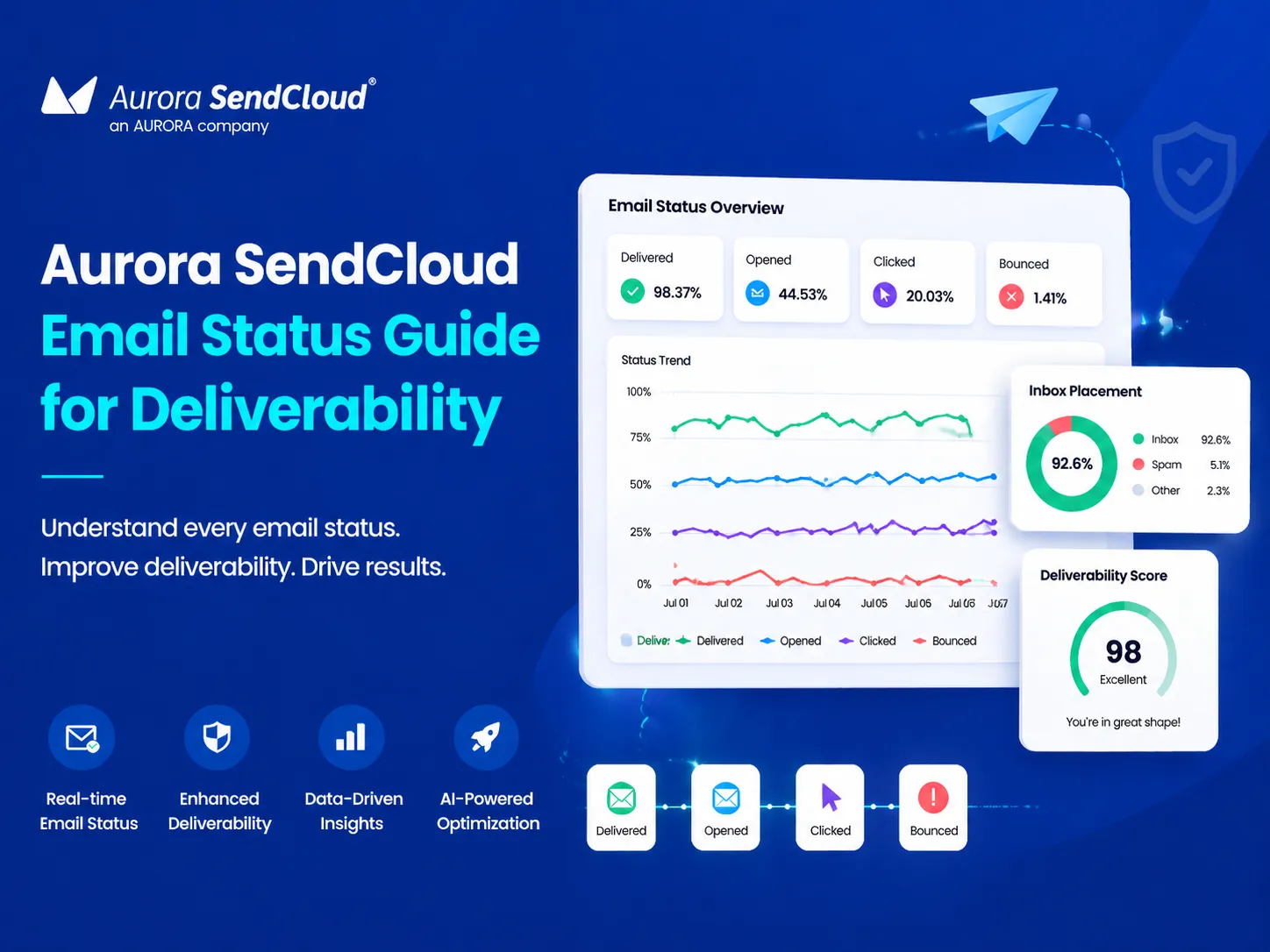
A solid provider should help you reach 95%+ deliverability. Anything lower means trouble. Want to test it in real life? You can use seed lists, deliverability tools, or your own live campaigns to see where messages land. Aurora SendCloud gives you something special here: Inbox Insight. This feature doesn’t just say your email was delivered. It shows whether it reached the actual inbox. That’s a big deal because many services hide this level of detail.
Comparison tip: Always ask providers for their deliverability rate based on your industry. If they can’t share it, consider it a red flag.
2 AI-Powered Content and Creation Tools: A Modern Game Changer
Content matters. Bad subject lines lower open rates. Weak copy loses attention. And boring templates make your readers leave fast. That’s why AI tools are becoming a huge advantage in the world of email.
Aurora SendCloud stands out with strong AI features such as:
- AI-generated email content
- AI-powered subject line optimization
- AI image creation
- AI template design
These tools help you create emails that feel polished and engaging, even when you’re short on time. Not every platform offers this level of personalization, and some well-known providers fall behind here. AI doesn’t replace your creativity; it boosts it.

3 Advanced Analytics and Multi-Dimensional Reporting
This metric is all about understanding your audience. A good provider shouldn’t stop at counting opens and clicks. You need deeper insights to grow.
Look for services that show:
- Reading time
- Device data
- Geographic distribution
- Timestamped engagement
- Bounce reasons
- Complaint rates
Aurora SendCloud offers multi-dimensional analysis that checks all these boxes. It even uses something called MP data analysis, which studies actual sending distribution to give you more accurate results. When your reporting is strong, your decisions get smarter. You’ll know exactly when to send messages, what content your audience prefers, and what causes engagement to drop.
4 Pricing, Value and Transparent Cost Structures
Let’s be honest; price matters. But cheaper isn’t always better. Some platforms offer attractive starter plans but hide fees later. Others require custom pricing that makes it hard to compare.
Here’s what to look for:
- Straightforward volume-based pricing
- No hidden fees
- Clear overage rules
- Fair billing cycles
- Useful free trials
Aurora SendCloud follows a transparent model. You know exactly what you’re paying for. On the other hand, some services like Emarsys offer custom quotes that make it harder to predict your true costs. Transparency saves you headaches down the road. If a provider has a free trial, use it wisely. Test sending speed, analytics accuracy, warm-up support, and more, not just the basic features.

5 Ease of Integration and Comprehensive API Support
Developers play a big role in choosing a transactional email service comparison. If the integration is hard, teams waste hours. A good provider makes onboarding smooth, simple, and quick.
Key things to check:
- API documentation clarity
- Domain setup time
- SDK availability
- Error messaging
- SMTP support
- Sandbox testing
Aurora SendCloud uses standard API and SMTP protocols. Its SDKs support popular languages like Python, PHP, Java, Node.js, Go, and more. This makes it easy for both small startups and large SaaS teams to integrate fast. The faster you can send your first message, the sooner your system runs at full speed.
6 Proactive Support, Warm-Up Plans and Sending Diagnostics
Support can make or break your experience. When something goes wrong in email, it can feel like the sky is falling. Maybe your domain reputation drops. Maybe your messages bounce for no clear reason. That’s why proactive support matters.
Look for services that offer:
- Fast response times
- Live support channels
- Knowledge base access
- Dedicated technical help
- Deliverability consulting
Aurora SendCloud shines with warm-up plans from day one, which is something services like AWS SES don’t offer. It also keeps an eye on your domain and IP reputation constantly. If something looks off, you get alerts and detailed reports. This is a huge advantage because AWS SES and similar services require customers to diagnose problems on their own. Warm-up guidance can protect your sender reputation and keep your email performance steady.
7 Security, Authentication and Global Compliance
If deliverability keeps your emails seen, security keeps your business safe. A good provider should help you set up:
- SPF
- DKIM
- DMARC
These protect your domain from spoofing and improve inbox trust. You should also check compliance standards. Are they supporting GDPR? CAN-SPAM? Do they encrypt data? Do they offer access controls and monitoring tools? Trust is everything in email. A strong platform will have built-in protection at every step.
Common Beginner Mistakes to Avoid
Even smart teams slip up when evaluating providers. Here are mistakes to steer clear of:
- Underestimating setup complexity: Some platforms look simple but require technical steps that newcomers miss.
- Ignoring authentication: Without SPF, DKIM, and DMARC, deliverability crashes fast.
- Choosing based only on price: What looks cheap today could cost you conversions tomorrow.
- Skipping mobile checks: Most people read email on their phones. A bad mobile layout hurts results.
Avoiding these mistakes makes your whole process smoother and helps you choose wisely.
Conclusion:
Choosing the best email delivery service becomes much easier once you understand the seven key metrics that shape email performance. Start by looking at deliverability, because reaching the inbox sets the stage for everything else. Then consider analytics, pricing transparency, ease of integration, support quality, and security.
Every business has different needs. Startups often benefit from simple onboarding. They also look for low costs and strong guidance. Mid-size SaaS or e-commerce teams usually want scalability. They depend on AI tools and real-time reports. Enterprises need top-tier deliverability. They also require smart diagnostics, strong compliance protection, and global infrastructure.
The smartest next step is to test a few providers with real campaigns and compare their results using the metrics we covered. When you measure what truly matters, you’ll know exactly which platform fits your goals. And if you want a faster, easier way to improve your email performance, try Aurora SendCloud’s powerful deliverability tools, AI features, and inbox-ready infrastructure by visiting our website today.